
Day 14 of our 33days total consecration class

Pope Francis sends a message to the people of the Dominican Republic, as they prepare to mark the Altagracian jubilee year, and urges each person to entrust themselves to the care of the Virgin Mary, kindling the flame of hope.
By Francesca Merlo
Pope Francis on Saturday greeted, with affection, all “the brothers and sisters of the beloved Dominican Republic”, as they prepare to celebrate the jubilee year of the canonical coronation of Our Lady of Altagracia, Mother and Protectress of Dominicans.
The Pope noted that “this Marian devotion so deeply felt by you is a sign of the Christian roots that characterise and give life to your land”. It is for this reason, he said that he exhorts each Dominican “not to lose heart in your witness of faith, to care for and strengthen, through the example and intercession of the Virgin Mary, your love for Jesus and for the Church”.
Closeness and tenderness
Pope Francis went on to explain that through the Virgin, God gives us a sign of His closeness and of the infinite tenderness with which He cares for us. “The loving gaze of the Mother contemplating the Child who sleeps confidently on her lap is an invitation for us to learn to see, through her eyes, Jesus present in our neighbours, and to remember that we are part of the same human family called to live together in fraternity and solidarity”, stressed the Pope.
In this way, he continued, “the Virgin of Altagracia has been, for the Dominican, people a source of unity in difficult moments and a sure hand that supports them in the setbacks that arise in their daily lives”. It is with her protection and shelter that she urges us to take care of and keep “burning the flame of hope that our elders bequeathed to us in faith, and to pass it on to others with humility, trusting in the grace of the Lord”, sais the Pope.
Walk together
Bringing his message to an end, Pope Francis urged his Dominican brothers and sisters not to be afraid to walk together, beyond divisions and mistrust, united in fraternity in the direction that Jesus indicates in the Gospel. “Do not hesitate to seek God’s will in simplicity, for He is a Father of tenderness who embraces all and never abandons us”, said the Pope, and “trust that His divine light transforms hearts and leads them to an encounter with him and with their brothers and sisters; and have faith that the power of the Holy Spirit impels you to carry out with joy and constancy works of love and goodness for those who need it most”.
Finally, he prayed “that Jesus bless you and Our Lady of Altagracia protect and accompany you”
PARABLE The Greek word occurs frequently in the Greek Old Testament as the translation of the Hebrew word mashal, meaning: proverb, by-word, wise saying, similitude, parable. It occurs with especial frequency in the Synoptic Gospels, where the parable is a characteristic of the teaching of Christ, not in the sense that Christ created the type (for we find parables occasionally in the Old Testament, and, independently, in Rabbinic Literature), but in the sense that Christ made a very special use of the parable; after Him the Apostles do not seem to have used it in their teaching. As used in the Gospels, the word parable means a narrative of more or less fictitious character, but dealing with objects or occurrences taken from nature or the life of man, which serve as terms of comparison to illustrate a supernatural truth of the moral, religious order. In this narrative the expressions are to be understood in their ordinary sense, the words keeping their natural literal sense. The parable thus differs from the allegory in which the words are used in the figurative sense, the allegory being really a series of metaphors, as for instance when Our Lord says: I am the Good Shepherd; the Door; the Vine, etc. (John 10:15). It differs from the fable or apologue (which is not represented in the New Testament) in that the latter uses as actors, plants or animals, etc., which are made to speak and act more or less unnaturally, and in that the fable teaches a truth of the natural order or common sense. In the Gospels we find parables and allegories, and an intermediate class in which both kinds are more or less mixed. To understand a parable correctly, we must ascertain the precise point of the comparison, and subordinate the rest to that point, without trying to find a lesson in each one of the details of the story: several of the details are there simply to give consistency and interest to the narrative, but are not intended to convey a lesson. Thus for instance illthe parable of the Cockle (Matthew 13:24 sq.) the sleep during which the enemy oversows cockle, and the servants of the good man of the house conceal no special mystery. Accordingly one must beware of finding in a parable a lesson about a point which the parable is not meant to illustrate, and of making applications to cases not intended by Our Lord: thus from the fact that one-fourth of the seed yields fruit (Matthew 13:3-9; 18-23) we may not infer that only one-fourth shall be saved. The parables, the number of which is given quite differently by the different authors, according to their more or less strict definitions of “parable,” deal with truths of moral religious character, e.g., Prodigal Son, the Two Debtors; or with the Kingdom of God in its various aspects (nature, growth, consummation, etc.): see Matthew 13; these latter parables concerning the Kingdom of God are in fact prophecies of Our Lord concerning the future development of His work.

GRACE In its widest meaning, the term signifies any gratuitous gift of God to a rational creature, the bestowal of which is motivated by divine benevolence, whether the gift be natural or supernatural, internal or external to the recipient. In its strict and ordinary sense, however, grace is a supernatural gift of God’s beneficence, gratuitously bestowed upon a rational creature (angel or man), for the ultimate purpose of fitting the recipient for life eternal. It may be inward or external, as is explained under these titles: Inward grace is either actual or habitual, according as it consists in a transitory help conferred for the performance of a good act, or in an abiding perfection elevating the recipient in a manner to a divine plane of being. This latter is usually called sanctifying grace, because of its formal effect on the recipient. Its very presence sanctifies him, makes him holy, a child of God, and an heir of heaven. Sanctifying grace is always accompanied by the infused virtues and the gifts of the Holy Ghost, both of which share in the general nature of supernatural grace. They are permanent perfections of the recipient’s spiritual faculties” intellect and will, bearing a somewhat similar relation to sanctifying grace as the natural faculties and their dispositions bear to the soul. Hence by sanctifying grace, and its concomitant gifts, the recipient is in a manner constituted a supernatural nature, a complete radical principle of salutary action. In reference to its origin, a distinction is made between the grace of God and the grace of Christ. All grace comes indeed from God, but since the fall every grace bestowed upon human beings is based on the merits of Christ. Before the fall Adam received grace directly from God, without reference to the Saviour of mankind; and so did the angels whilst they were oh probation. But now we, the children of the fallen Adam, receive grace only through Christ Our Lord. Grace is so necessary that without it we cannot do anything for life eternal. Hence the words of Christ: “Without me you can do nothing” (John 15).

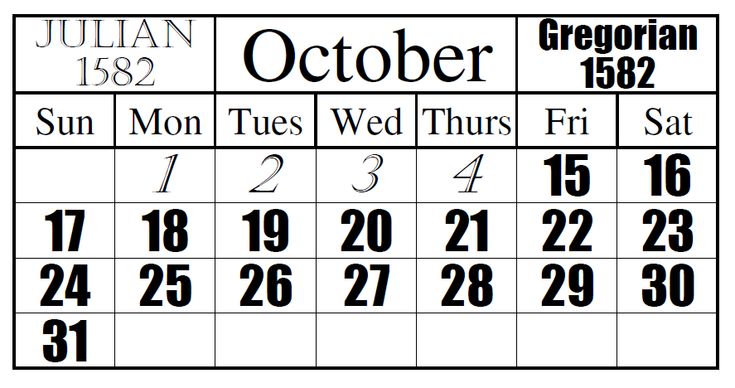
THE CHURCH’S CALENDAR The Church’s calendar depends on the calendar in use at the present time, which is known as the Gregorian, from Pope Gregory XIII, by whose decree it was brought to its present form. As the length of the year depends on the time of the earth’s journey around the sun, and as that journey is not completed in exactly 365 days, Julius Cresar made each fourth year a “leap year” by inserting an additional day in February. The Julian Calendar, however, was inaccurate; the journey of the earth is made in a little less than 365 days, and a constantly increasing error resulted. In Pope Gregory’s time, 1582, it amounted to 10 days; he therefore dropped these from the calendar and ordered that the leap year should be observed in the year 1600, but not in 1700,1800, and 1900, and that thereafter century years would be leap years only when they are divisible by 400. This gives a year so nearly exact that there will be an error of one day in 35 centuries. The calculations were made principally by two astronomers, Lulli and Clavius. Protestant countries for a time refused to use the Gregorian Calendar. England did not accept it until 1752, and Russia, which was 13 days behind the rest of the world, adopted it only recently.
One Heaven for All? Do people of different denominations go to the same heaven? Or is there any difference after death where different faiths go? The answer is pretty straight forward. There is only one Heaven and everyone who goes to Heaven goes to the same Heaven. So, no matter what your faith may be, if you go to Heaven you go to the one and only. But allow me to explain a bit about the beautiful reality of Heaven and what we actually believe about it. First, Heaven is not a “place.” Rather, Heaven is a “state of being.” Now that may, at first, sound a bit deep and philosophical. But it makes perfect sense when understood properly. When speaking about Heaven we often use language that implies it is some place we go to. Somewhere up there! But Heaven is not some location in this universe. It is, properly speaking, a state of being completely and totally united with God! Heaven, in a real sense, is a Person. The Person is Jesus Christ. Our goal in life is to enter into complete union with Him now and for eternity. Heaven, therefore, is simply the final state of complete union with Jesus after death. It is the permanent unbreakable bond or unity and oneness we will share with Him. And since He is completely united with the Father and the Holy Spirit, Heaven is a state of being fully immersed in the life of the Most Holy Trinity. Secondly, I think it’s important to know that Heaven is to begin here and now. Throughout our life on earth we are called to be continually purged of our attachment to sin so as to walk, day by day, ever more deeply united to God. The deeper that unity the more we are detached from sin and the more we share in the state of Heavenly unity right now! Of course, as long as we are alive in this world we will always be tempted and usually be drawn back to sin on various levels. So the fullness of Heaven comes only after this life when we will never lose that full union with God again. This also begs the question, “What is Hell?” Sadly, Hell is simply the complete loss of God and, thus, the complete separation from Him. Here and now, a “living hell” is when one lives in a state of unrepented mortal sin. In that state there is no union with God, no joy in life and no fulfillment. If one dies in that state he/she remains forever separated from God. And lastly, let me mention that Purgatory is the state of being purified of our sins and even our attachment to sin. It is a process that should begin now but will be completed upon death if we still have some attachment to sin. But even though it may be painful, in a sense, to be purged from sin, it is also joyous in that we are freed from those unhealthy bonds.
CHARITY A supernatural, infused virtue, by which we love God above everything for His own sake, and our neighbor as ourselves for God’s sake. As an act of supernatural virtue it requires a motivation based on Divine revelation. Charity, in the strict sense of the word, cannot exist in a person who has never heard of revelation, though he may perform many works from the sole motive of pleasing God. Charity, unlike natural virtues, is not acquired through frequent repetition of the same acts, but is infused with sanctifying grace; hence it is sometimes used to signify this grace. It is a Divine name: God is charity (1 John 4:16). Almsgiving is called charity because it is one of its principal works. Today, outside of the Catholic Church, charity signifies any good turn done to the needy, regardless of the motive that prompted it.

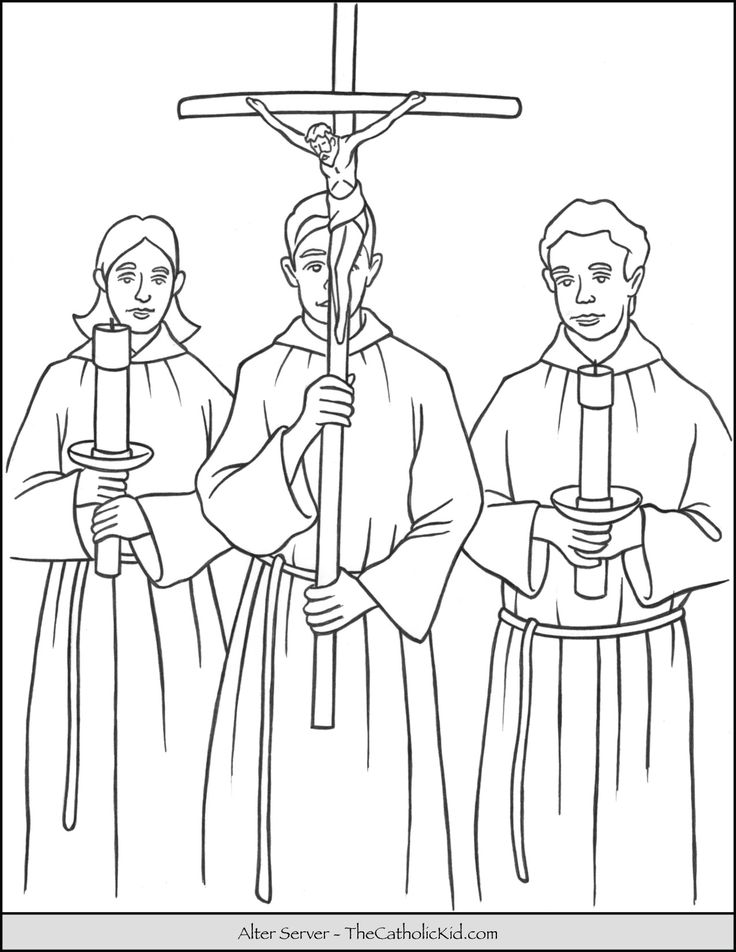
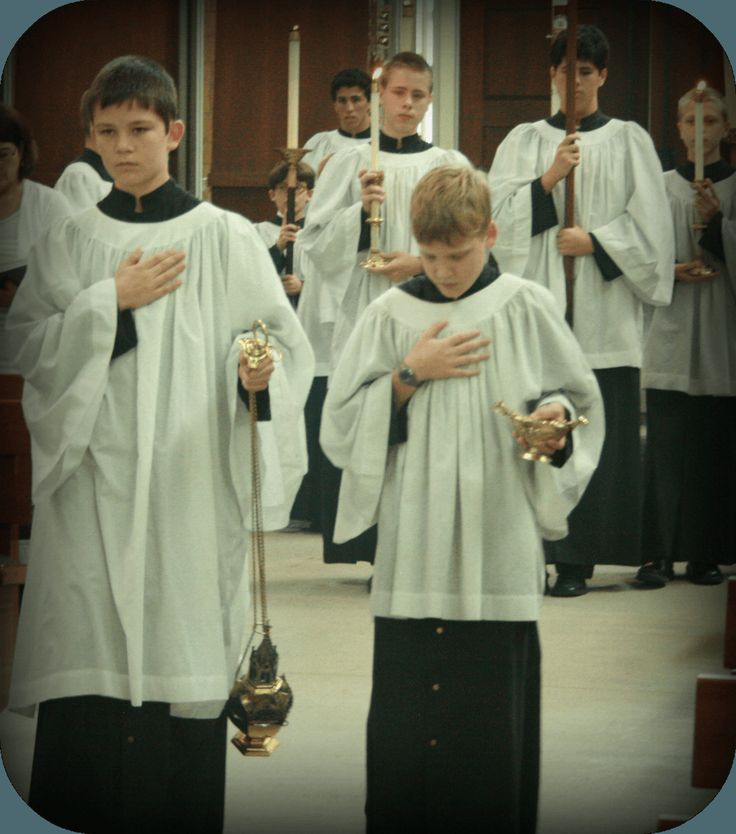
Why Altar Servers? Why does the priest need altar servers? Simply put, altar servers make the practical aspects of the Liturgy flow more smoothly. At least most of the time when they are well trained. An altar server holds the book for the priest when praying from the chair. They hold candles next to the Gospel as it is being proclaimed. They assist with incense, assist with the preparation of the altar and perform other helpful functions. Additionally, on a personal level, serving the holy Mass is a great honor and helps young people, especially, to learn the Mass well so that they can better join in the offering. Being present in the sanctuary, dressing in server cassocks or albs, and being attentive to the flow of the liturgy should hopefully have the effect of helping servers to grow in a deeper love and reverence for the Mass. Also, at times and in cultures where boys act as altar servers, this helps plant the seed of a vocation in the minds and hearts of those whom God is calling to serve as priests. With that said, symbolically the servers also represent the entire people of God, especially in the procession. At Mass, we should all see ourselves on a spiritual journey toward Heaven. The sanctuary is the symbol of Heaven and the procession symbolizes the entire people of God journeying toward Heaven with the Cross leading the way. At a gathering in Rome with about 9,000 altar servers, Pope Francis told the servers that serving at the altar “enables you to open yourselves to others, to journey together, to set demanding goals and to find the strength to achieve them.” He went on to say, “The closer you are to the altar, the more you will remember to speak with Jesus in daily prayer; the more you will be nourished by the word and the body of the Lord, the better able you will be to go out to others, bringing them the gift that you have received, giving in turn with enthusiasm the joy you have received.” If you know an altar server, make sure to thank them for their service and encourage them in their important role.
 Marian child